Forebet Mathematical Prediction: Understanding Football Statistics, Algorithms and Match Probabilities
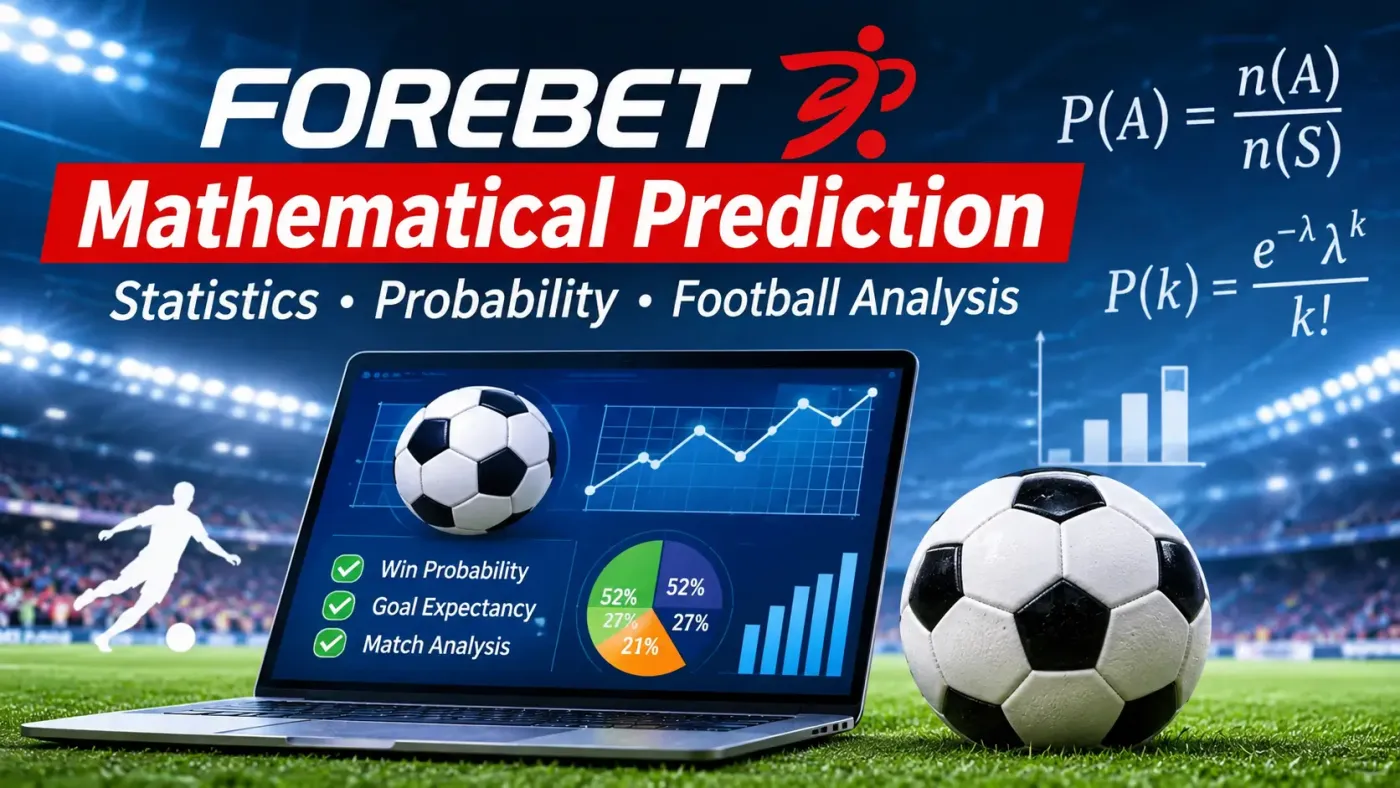
"Forebet Mathematical Prediction" is a search term associated with the use of mathematical models, statistics, and probability to understand football matches. Football has become increasingly data-driven, with statistical information helping supporters understand team performances, historical results, and possible match outcomes.
Mathematics plays an important role in modern football analysis. From goals scored and conceded to home and away performances, different statistical measurements can provide useful information about how football teams perform.
Forebet is a recognized name associated with mathematical football predictions. Its approach has attracted attention from football followers interested in understanding how statistics and mathematical calculations can be applied to the sport.
In this guide, we explore Forebet Mathematical Prediction, how mathematical football models work, the importance of football statistics, probability calculations, and the limitations of using historical information to understand future results.
What Is Forebet Mathematical Prediction?
"Forebet" mathematical prediction refers to the use of mathematical calculations and statistical models to examine football matches and estimate possible outcomes.
Mathematical football analysis involves collecting historical information and applying statistical methods to identify patterns in team performances.
Some of the information commonly considered in mathematical football models includes:
-
Previous match results.
-
Goals scored by each team.
-
Goals conceded.
-
Home and away performances.
-
League standings.
-
Historical team records.
-
Attacking and defensive statistics.
-
Average goals per match.
These statistics help mathematical models describe football performance using numerical information.
Unlike opinions based entirely on team reputation, mathematical models use measurable information. However, their conclusions remain estimates rather than guaranteed descriptions of future events.
How Does Mathematical Football Prediction Work?
Mathematical football models use historical data to estimate the likelihood of different match outcomes.
The process generally involves collecting information, organizing the data, selecting suitable statistical methods, and calculating probabilities.
For example, a model examining two football teams may consider their recent scoring records and defensive performances.
If Team A regularly scores more goals than Team B, the model may identify a difference in their attacking statistics.
However, this does not automatically mean Team A will win their next match. Football outcomes can change because of injuries, tactical decisions, player availability, and unexpected events.
Mathematical models provide a structured way to study football rather than relying entirely on assumptions.
The Role of Statistics in Forebet Mathematical Prediction
Statistics are an important part of mathematical football analysis.
They allow analysts to compare teams using measurable information instead of relying only on general impressions.
Some of the most important football statistics include the following.
1. Goals Scored
Goals scored measure how many times a team has found the back of the net during a particular period or competition.
This statistic provides information about attacking performance.
For example, a team that has scored 20 goals in 10 league matches has an average of two goals per match.
The calculation is straightforward:
AverageGoals=TotalGoalsScoredMatchesPlayed
This measurement helps describe a team's scoring record.
2. Goals Conceded
Goals conceded show how many goals a team has allowed its opponents to score.
This statistic provides information about defensive performance.
A team that concedes fewer goals over several matches may have a stronger defensive record than a team that regularly allows opponents to score.
However, goals conceded should be considered alongside the quality of opposition and the number of matches played.
3. Home and Away Statistics
Football teams sometimes perform differently depending on whether they play at home or away.
Home statistics examine performances in a team's own stadium, while away statistics examine performances at opposing grounds.
Comparing these records can reveal differences in scoring patterns and defensive performance.
4. Recent Form
Recent form examines a team's results over a selected number of previous matches.
For example, a team's last five results may include three wins, one draw, and one defeat.
This information provides a short overview of its recent performances.
However, recent form should not be treated as a guarantee of future results.
5. Head-to-Head Records
Head-to-head statistics examine previous meetings between two football clubs.
They may show how frequently teams have won, drawn, or lost against each other.
Although historical meetings can provide useful background information, previous results do not determine what will happen in a future fixture.
Understanding Probability in Mathematical Football Models
Probability is one of the most important concepts in mathematical football analysis.
It measures how likely an event is to occur based on available information and the assumptions of a particular model.
For example, a statistical model may estimate the probability of a home win, a draw, or an away win.
The three possible outcomes are commonly represented as
-
Home win.
-
Draw.
-
Away win.
These outcomes form the basic 1X2 classification used in football statistics.
A probability model may assign different percentages to each outcome. The percentages should add up to 100% when the three outcomes are mutually exclusive and collectively exhaustive.
For example:
|
Possible outcome |
Illustrative probability |
|
Home win |
50% |
|
Draw |
28% |
|
Away win |
22% |
|
Total |
100% |
These figures are only an educational example, not a prediction for a real football match.
Probability helps explain uncertainty. An outcome with a higher estimated probability is not guaranteed to happen.
How Mathematical Models Examine Football Scorelines
Football scorelines provide another area where mathematical methods can be applied.
Statistical models can estimate the expected number of goals for each team using historical scoring and defensive information.
One established statistical method is the Poisson distribution.
The Poisson distribution is used in different fields to model the number of times an event occurs within a defined period or interval.
In football research, it can be used to study goal-count patterns.
For example, researchers may use historical scoring information to estimate the probability of a team scoring zero, one, two, or more goals.
This helps explain how mathematical models approach football scoreline analysis.
However, actual football matches involve many factors that cannot always be represented accurately through a simple mathematical distribution.
Forebet Mathematical Prediction and Artificial Intelligence
Artificial intelligence has become increasingly important in sports analytics.
Modern football analysis can involve machine learning, statistical modelling, and large datasets.
These technologies help researchers identify patterns across thousands of football matches.
For example, machine learning systems can examine relationships between:
-
Team scoring records.
-
Defensive performances.
-
Player statistics.
-
Match locations.
-
Previous results.
-
Competition performance.
Artificial intelligence can process large amounts of information faster than traditional manual analysis.
However, the quality of any mathematical model depends heavily on its data, assumptions, and design.
A complicated algorithm is not automatically more accurate than a simpler statistical model.
Why Historical Football Data Matters
Historical football data provides the foundation for many mathematical models.
Without previous information, it would be difficult to identify long-term scoring patterns, defensive records, and differences between teams.
Historical data can help researchers answer questions such as:
-
How many goals does a team score on average?
-
How frequently does a team concede?
-
Does a club perform differently at home and away?
-
How have two teams performed in previous meetings?
-
How does a team's performance change throughout a season?
These questions help explain the relationship between statistics and football performance.
Nevertheless, historical information has limitations. A team's previous performance may not accurately represent its current squad or playing conditions.
Factors That Can Affect Mathematical Football Predictions
Even sophisticated mathematical models cannot account perfectly for everything that happens during a football match.
Several factors can influence actual match outcomes.
Player Injuries and Suspensions
The absence of important players can affect a team's attacking or defensive structure.
An injury to a key striker, for example, may change the team's attacking options.
Tactical Changes
Football managers regularly adjust their formations and playing approaches.
A tactical change can affect possession, attacking opportunities, and defensive organization.
Team Motivation
The importance of a particular fixture may influence how a team approaches a match.
A club fighting for a league title may have different objectives from one that has already secured its position.
Weather Conditions
Heavy rain, strong winds, and other weather conditions can affect playing surfaces and match conditions.
Unexpected Match Events
Football is unpredictable. Red cards, penalties, defensive mistakes, and individual moments of quality can change a match.
These factors explain why mathematical estimates should never be treated as certain outcomes.
Forebet Mathematical Prediction Compared With Traditional Football Analysis
Mathematical analysis and traditional football analysis approach the sport differently.
Mathematical analysis focuses on numerical information, probability and statistical relationships.
Traditional football analysis often considers tactical systems, player quality, managerial decisions and observations from previous matches.
Both approaches have advantages and limitations.
|
Mathematical analysis |
Traditional analysis |
|
Uses statistical information |
Uses football knowledge and observation |
|
Examines numerical patterns |
Examines tactics and playing styles |
|
Applies probability models |
Considers team circumstances |
|
Depends on data quality |
Depends on the quality of observations |
|
Helps measure uncertainty |
Provides tactical and contextual explanations |
Combining statistical information with football knowledge can provide a broader understanding of team performances.
Why Football Fans Search for Forebet Mathematical Prediction
Interest in mathematical football analysis continues because supporters want to understand how statistics can explain the game.
Searches for Forebet Mathematical Prediction may come from people interested in statistical football models, probability calculations and the relationship between historical results and future performances.
Some readers also want to understand how football prediction platforms organise their information and what mathematical methods are involved.
Learning about these concepts makes it easier to interpret statistical information without assuming that mathematical calculations can remove uncertainty from football.
Frequently Asked Questions About Forebet Mathematical Prediction
1. What is Forebet Mathematical Prediction?
Forebet Mathematical Prediction is a search term associated with mathematical and statistical approaches to football outcome estimates. It relates to using historical football information and probability models to examine matches.
2. How do mathematical football predictions work?
Mathematical football models use historical data, scoring records, defensive statistics and probability calculations to estimate possible match outcomes.
3. What is the Poisson distribution in football?
The Poisson distribution is a mathematical method that can be used to model the number of goals scored by football teams within a match.
4. Does mathematical football analysis guarantee accurate results?
No. Mathematical models provide estimates based on available information. Unexpected events and changes in team conditions can affect actual match outcomes.
5. Why are home and away statistics important?
Home and away statistics help identify differences in how football teams perform depending on the location of a match.
6. Does artificial intelligence improve football analysis?
Artificial intelligence can help process large datasets and identify statistical patterns. However, its usefulness depends on data quality, model design and appropriate interpretation.
7. What statistics are important in mathematical football analysis?
Common statistics include goals scored, goals conceded, recent results, home and away performances, league position and historical head-to-head records.
8. Can mathematical models predict exact football scores?
Mathematical models can estimate the probabilities of different goal totals and scorelines. However, they cannot guarantee an exact final score.
Final Thoughts on Forebet Mathematical Prediction
Forebet Mathematical Prediction highlights the growing relationship between mathematics, statistics and football.
Mathematical models provide useful ways to examine historical results, scoring patterns, defensive performances and probability. They also help explain how numerical information can be applied to football analysis.
However, football remains a sport where uncertainty is unavoidable. Injuries, tactical changes, player performances and unexpected events can influence the outcome of any match.
At Todayspredict, we believe understanding football statistics is important for anyone interested in the modern game. Learning how mathematical models work helps football followers interpret statistical information more carefully and understand the limitations of data-based analysis.